
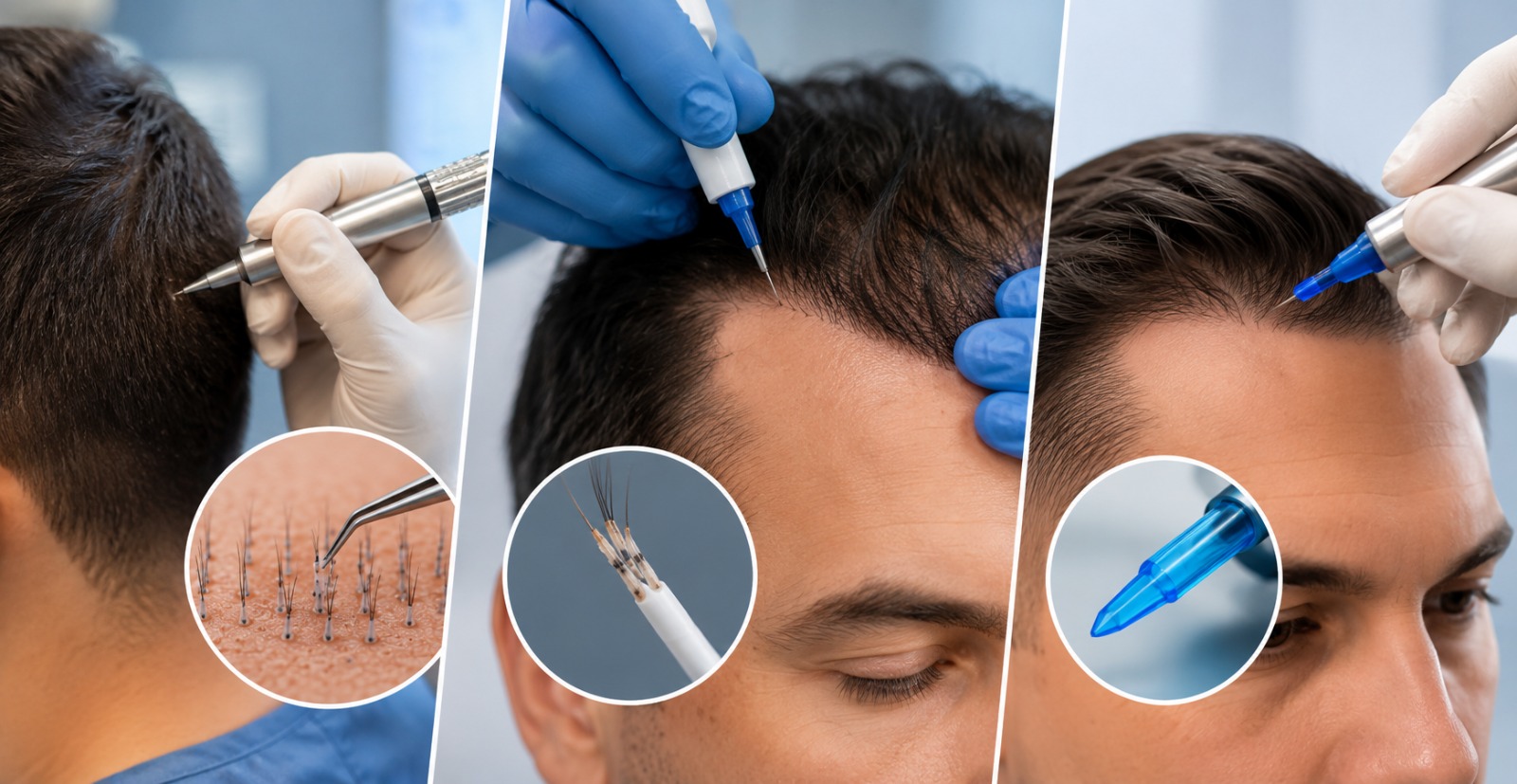
When taking the initial steps regarding hair transplant surgery in Jaipur, it might seem a bit confusing to choose between FUE, DHI, and Sapphire, as they are all different. Every clinic claims its method is the best, and online reviews often vary. This guide explains the actual differences so that you can enter into your consultation with a definite list of questions and not a lot of assumptions.
Hair loss is an intimate matter. A hair transplant technique that is suitable for your friend may not be suitable for you because the density of the donor hair, the texture of the donor hair, and the degree of baldness all factor into the choice of hair transplant technique your surgeon recommends.
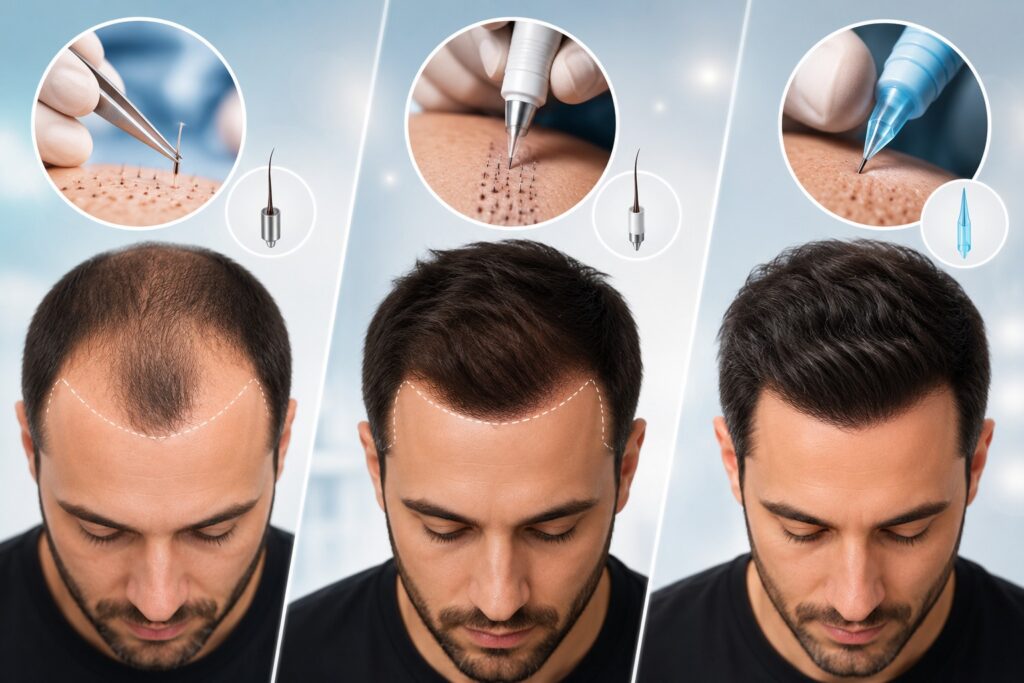
1. What Is FUE Hair Transplant?
The most commonly used technique in the majority of Indian clinics is follicular unit extraction.
- Individual grafts get removed one at a time from the donor area.
- Minimal scarring, since no strip of scalp gets cut.
- More rapid healing than the older strip techniques.
- Effective for mild to moderate thinning hair.
Most patients get better in a week and resume normal activities in no time.
2. What Is DHI Hair Transplant?
The Direct Hair Implantation technique is a refined process of the FUE technique that uses a special pen-like instrument called the Choi Implanter.
- Unlike traditional hair transplants, grafts are inserted directly into the scalp without making any cuts.
- Surgeons have greater control over direction, depth, and angle.
- In the hairline area, precision is most crucial, which is why it is very often chosen for hairlines.
- Sessions can be longer due to the individual placement of grafts.
This technique may require minimal bleeding in patients with tighter scalps.
3. What Is Sapphire FUE?
The recipient sites created with Sapphire FUE are made with blades fabricated of sapphire crystal rather than steel.
- Less tissue trauma with sharper, smoother cuts
- Because of this, a higher grafting density in a single session becomes possible.
- Scars will be less noticeable.
- Sometimes the recovery is smoother, but recovery times are still dependent upon the surgeon’s skill level.
It is also available in many clinics as a high-end option to the standard FUE.
4. How to Choose the Right Technique
So, which is the best hair transplant technique for you? But it’s a fair and honest guess that there isn’t one single winner. This depends on the phase of baldness, skin elasticity, budget, and the amount of time you can spend in the surgeon’s chair.
Consider these questions before making a decision:
- How much hair have I lost?
- What do I want to recover quickly or get the highest density of grafts?
- Does it have to be a natural hairline?
- How much money can I afford to spend?
All three approaches have resulted in good outcomes for patients in my practice. The technique is not as important as the surgeon’s experience and the thoroughness of the evaluation of your case before the surgery. Never be rushed into a decision in a good consultation. Any clinic that advocates for one technique without a thorough examination of your scalp should be viewed as a red flag.
Our hair transplant cost breakdown provides detailed information for you.
Conclusion
There is no magic bullet when it comes to selecting FUE, DHI, or Sapphire. It is about finding a match between the method and you and your objectives. Dr. Aakansha Vashistha has helped numerous patients come to this conclusion and will discuss the two scenarios—when the donor supply is enough and when it is not—as well as hairline desires and goals before deciding on a technique that will work best for a patient and not for a trend. Schedule a proper consultation, ask reasonable questions, and listen to your surgeon’s advice—don’t trust the marketing materials. The actual beginning of a hair transplant surgery in Jaipur is that.