

Written by Dr. Aakansha Vashistha, Plastic Surgeon
Many people assume that an intact hymen defines a woman’s character, but that is not true. Still, some women decide to undergo hymen repair, also called hymenoplasty, for personal, social or cultural reasons. It is entirely a personal choice, and the consultation should be approached with privacy, dignity and without judgment.
One important medical fact should be clarified from the beginning:
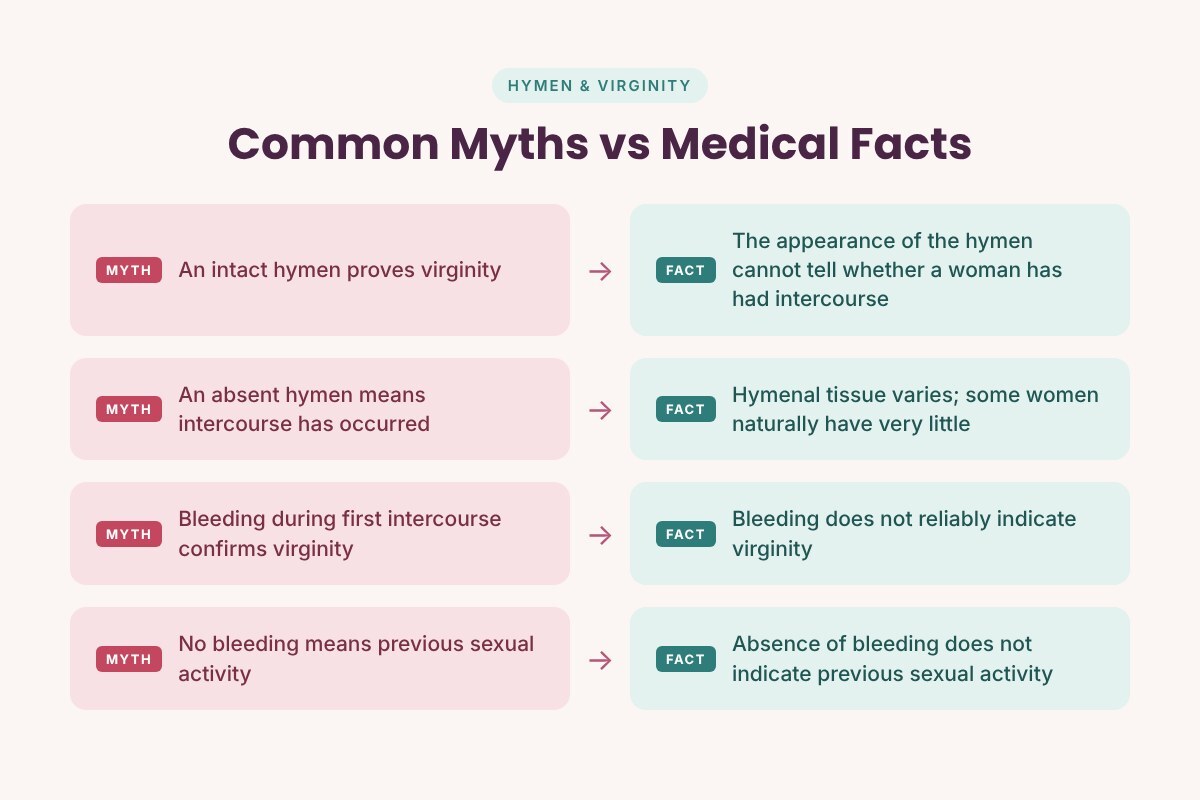
The appearance of the hymen cannot tell us whether a woman has had sexual intercourse.
What is a hymen?
The hymen is a tissue partially covering the vaginal opening. Its shape, thickness, elasticity and amount of tissue vary considerably from one woman to another. Some women naturally have very little hymenal tissue, while others have a more prominent rim.
Does an intact hymen mean proof of virginity?
No.
This is one of the most common misconceptions, and television and social media are largely to blame for it. The appearance of the hymen cannot reliably establish whether a woman has had sexual intercourse. The World Health Organization, UN Women and UN Human Rights have also stated that hymen examination has no scientific basis as a test of virginity (WHO interagency statement).
Similarly:
- An intact-looking hymen does not prove that someone has never had intercourse.
- An absent hymen does not prove that intercourse has occurred.
- Bleeding during first intercourse does not reliably indicate virginity.
- Absence of bleeding does not indicate previous sexual activity.
Why do women choose hymenoplasty?
There is no single reason. A woman may seek hymenoplasty because of:
- personal preferences
- cultural or family expectations
- anxiety surrounding an upcoming marriage
- previous sexual experience
- previous consensual or non-consensual trauma
- accidental or non-sexual injury to the hymenal tissue
The consultation should focus on the patient’s wishes, safety and informed consent, rather than making assumptions about why she is seeking the procedure.
If there is any concern about coercion, forced marriage, violence or potential harm from another person, the patient’s safety should take priority.
Is hymenoplasty the same as vaginal tightening?
No. This is a very common misunderstanding.
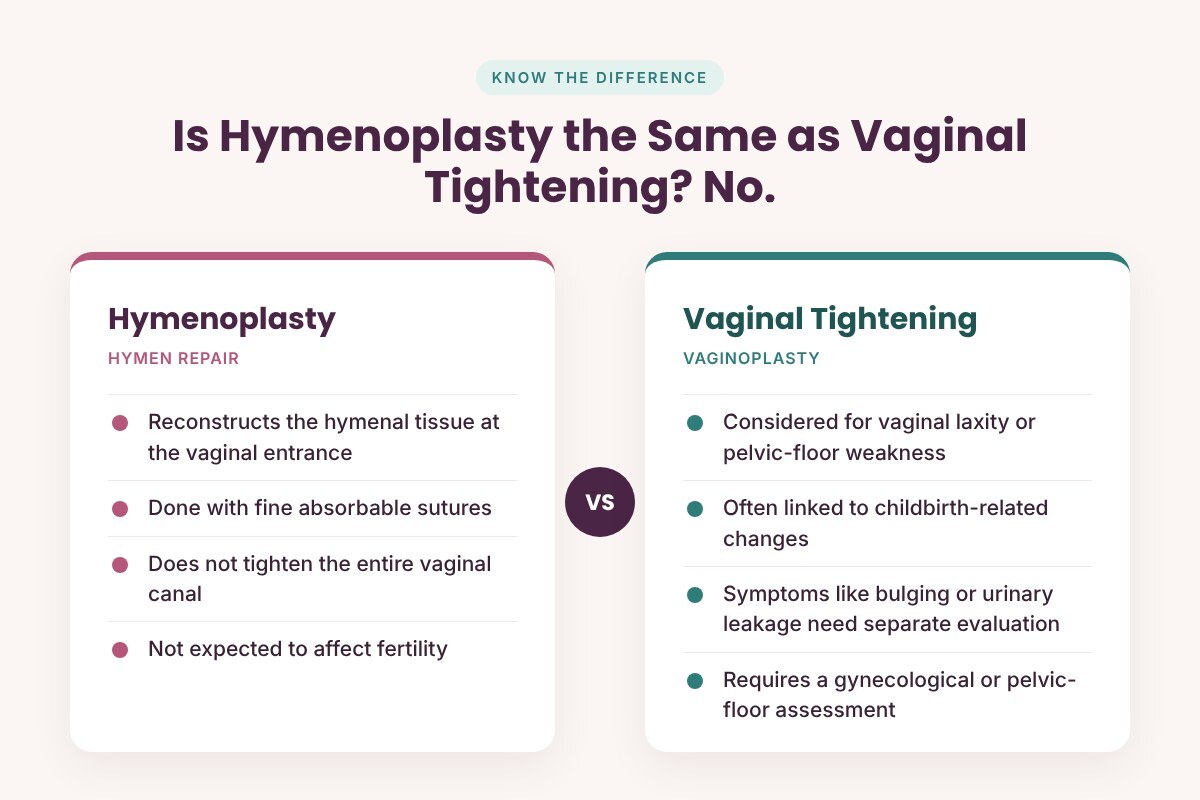
Hymenoplasty deals primarily with the hymenal tissue at the vaginal entrance. It does not generally tighten the entire vaginal canal.
If a woman has symptoms such as:
- vaginal laxity
- pelvic-floor weakness
- vaginal bulging
- urinary leakage
- pelvic organ prolapse
- pain following childbirth
she may require an entirely different gynecological or pelvic-floor evaluation. Read more about the signs you may need vaginal tightening surgery after childbirth.
What is the purpose of hymenoplasty?
Hymenoplasty aims to reconstruct the hymenal tissue. Depending on the individual’s tissue, the existing hymen is identified and sutured together with fine absorbable sutures.
How is hymenoplasty performed?
Hymenoplasty is usually a short day-care procedure. It is generally performed under local anesthesia, with or without sedation. In some cases, general anesthesia may be preferred.
In most cases:
- the patient can go home the same day
- absorbable sutures are used, so they do not need to be removed
The exact technique depends on how much hymenal tissue is present. This can be decided only after examination.
Who can have hymenoplasty?
Hymenoplasty is considered only for adult women (18 years and above) who are taking the decision on their own.
How to prepare for hymenoplasty?
Before the procedure, a detailed consultation and a gentle local examination are done in complete privacy. Patients may be advised to:
- get routine blood tests done
- get any vaginal infection treated first
- stop blood-thinning medicines like aspirin, only after discussing with their doctor
- plan the date away from the expected periods
- avoid smoking before and after surgery
Is hymenoplasty painful?
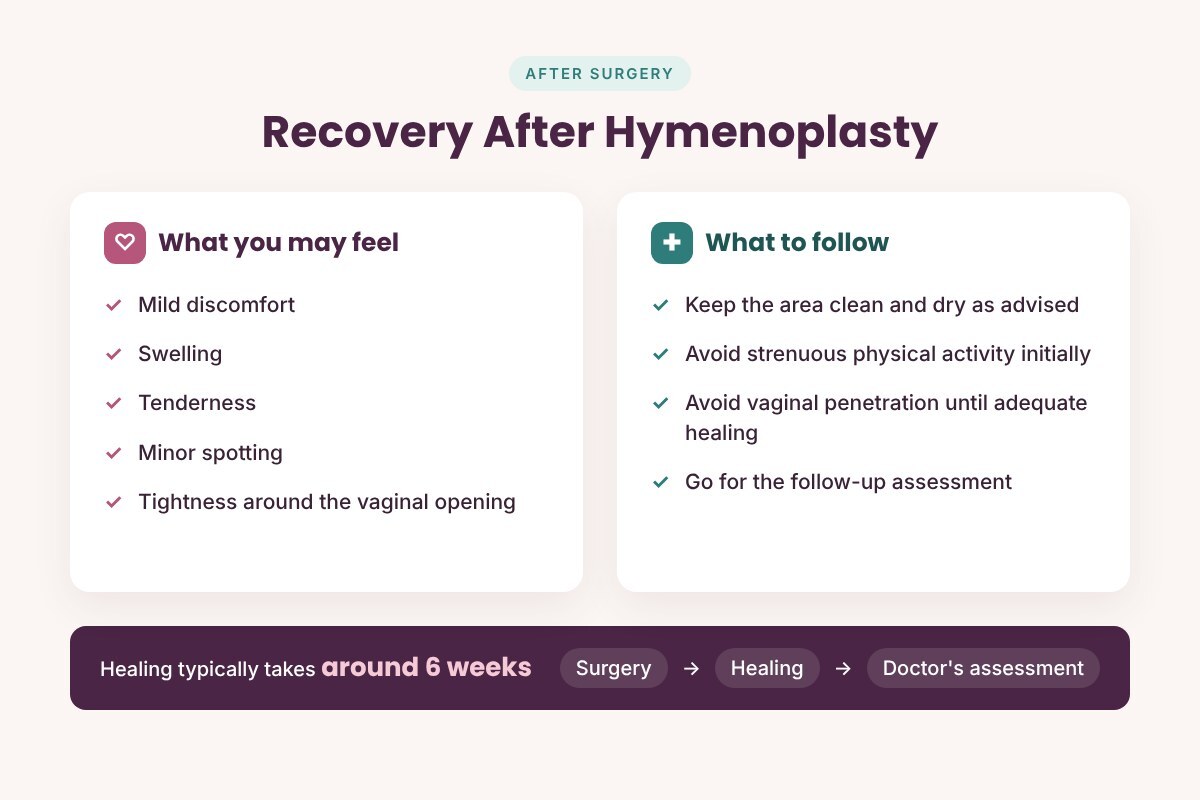
The procedure itself is performed with anesthesia, so significant pain during the procedure should not be expected. After surgery, there may be:
- mild discomfort
- swelling
- tenderness
- minor spotting
- a sensation of tightness around the vaginal opening
These symptoms usually improve as healing progresses.
How long does hymenoplasty recovery take?
Recovery varies depending on the technique used and the individual patient. Patients are generally advised to:
- keep the area clean and dry according to postoperative instructions
- avoid strenuous physical activity initially
- avoid vaginal penetration until adequate healing has occurred
Healing typically takes around 6 weeks. An assessment is then carried out, and after the examination the doctor will advise on any further activity restrictions if needed.
How many weeks before marriage should hymenoplasty be done?
There is no fixed rule, but timing matters. Doing it too close to the date may not leave enough time for healing and for the follow-up examination. The surgeon will advise the right timing after examination. If you are planning other treatments before the wedding, see our guide to cosmetic timelines for brides and grooms.
What are the possible risks of hymenoplasty?
Like any surgical procedure, hymenoplasty carries potential risks. These may include:
- pain or discomfort
- bleeding
- infection
- swelling
Rare complications have been reported in the literature, including narrowing of the vaginal opening and difficulty with penetration requiring removal of sutures.
Can hymenoplasty affect future fertility?
Hymenoplasty does not involve the uterus, ovaries or fallopian tubes. Therefore, appropriately performed hymen reconstruction is not expected to affect fertility.
Can hymenoplasty affect sexual intercourse?
Once healing is complete, hymenoplasty is not expected to cause any long-term problem with sexual intercourse.
The first intercourse after the procedure may feel tight and may cause some discomfort. Bleeding may or may not occur. Rarely, the opening may become too narrow and the sutures may need to be released.
Vaginal penetration should be avoided until the doctor confirms that healing is complete.
Hymenoplasty should not be confused with vaginoplasty or vaginal tightening surgery. A patient who is actually concerned about vaginal laxity, childbirth-related injury or pelvic-floor problems may require a completely different assessment.
Is hymenoplasty safe?
When performed on an appropriately selected adult patient by a qualified surgeon in an appropriate clinical setting, it can be performed as a surgical procedure with generally manageable risks.
Frequently Asked Questions
Can a doctor tell if I am a virgin by examining my hymen?
No. The hymen cannot reliably establish whether someone has had sexual intercourse.
Will I definitely bleed after hymenoplasty?
No. Bleeding cannot be guaranteed.
Can hymenoplasty erase my sexual history?
No. It reconstructs tissue; it does not medically establish or erase sexual history.
Does hymenoplasty affect fertility?
It does not involve the reproductive organs responsible for fertility and is not expected to affect fertility when appropriately performed.
Can the reconstructed hymen break?
The reconstructed tissue may stretch or separate depending on the surgical technique, healing and subsequent activity. The surgeon should explain the expected result and limitations beforehand.
How long does the procedure take?
The duration depends on the technique and individual anatomy. Your surgeon should provide an estimate after examination.
Can I have the procedure confidentially?
Medical confidentiality applies to patient care, subject to applicable law and clinical requirements. A patient should discuss confidentiality concerns with the treating clinic before the procedure.
Key Points
- An intact hymen is not proof of virginity, and the hymen cannot tell whether a woman has had sexual intercourse.
- Hymenoplasty reconstructs the hymenal tissue. It is not vaginal tightening.
- It is a short procedure done under anesthesia, and most women go home the same day.
- Healing typically takes around 6 weeks, and vaginal penetration should be avoided till then.
- It is not expected to affect fertility.
- The decision should be the woman’s own, taken with privacy, dignity and informed consent.
If you have questions about hymenoplasty, you can book a private consultation with Dr. Aakansha Vashistha.
This article is intended for general educational purposes and does not replace an individual examination or medical consultation.